
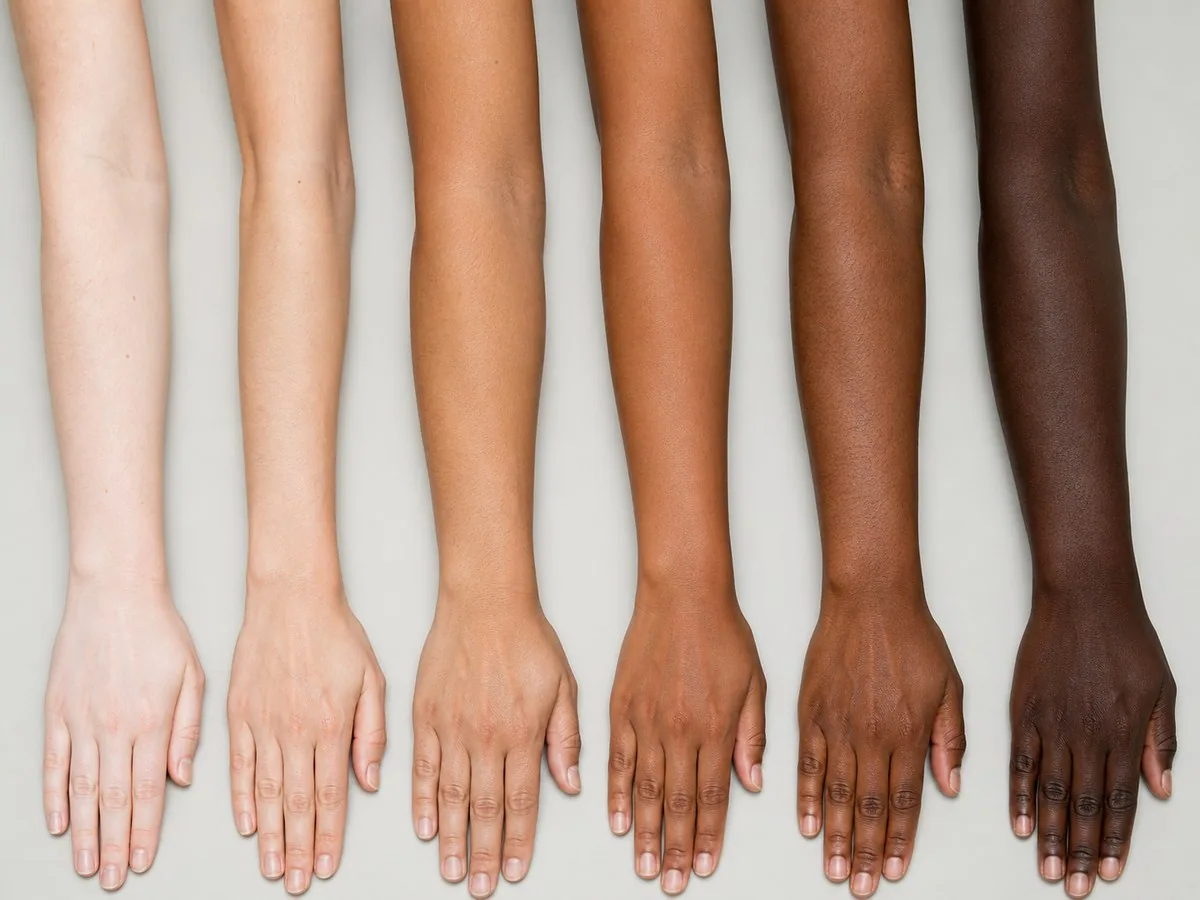

For darker skin — yes, with the right settings. The darker the skin, the more cautious the settings: for dark phototypes a session goes ahead only after an examination and a test patch.
Home / Guide / Phototypes
Guide · phototypes
Hair removal for darker and tanned skin
Laser safety comes down to the contrast between the skin and the hair. Four questions — and you will see your phototype I–VI and how a diode laser is set up for it.
Phototype test · 4 questions
30 seconds, no registration — the result appears on screen straight away
question 1 of 4
What is your skin like without a tan?
Darker and tanned skin is not a contraindication but a different protocol: more cautious settings, a mandatory examination and a test patch if there is any doubt. Below — the Fitzpatrick scale, four safety rules and answers to common questions.
Fitzpatrick scale
Six phototypes
Find yours. The test on the site gives a guide — the phototype and the settings are confirmed by a specialist at the examination.
IVery fair, always burns
IIFair, burns easily
IIIFair, tans gradually
IVOlive, rarely burns
VDarker, almost never burns
VIDark, never burns
Safety
Four rules for dark skin
The same in every salon in the network — regardless of the city and the specialist.
- 01 · Settings matched to the phototypeThe wavelength and the energy are matched to the tone of the skin and the hair — this is part of the protocol, not an option.
- 02 · A fresh tan — a pauseAfter strong sun or a sunbed we give the skin 2–4 weeks. In summer we work with SPF and without a fresh tan.
- 03 · A test at the examinationIf there is any doubt about how the skin will react, the specialist does a test patch and assesses the response.
- 04 · Honest limitsVery light, grey and red hair responds to the laser less well — we will say so directly at the consultation.
FAQ
Frequently asked questions
Still have questions?
Book an examination — the specialist will determine your phototype, check contraindications and select the settings at our Vilnius salon.
Available timeschecking the schedule…
Book an examinationAfter a strong tan we give the skin 2–4 weeks. A light gradual tan is not an obstacle: the device is set to your current tone at the examination.
The laser works on the pigment in the hair: very light, grey and red respond less well. We will say so honestly at the examination and suggest alternatives if the effect is going to be weak.
The same as after strong sun — 2–4 weeks, depending on the intensity and on your skin. The specialist will name the exact pause.
Yes, on exposed areas SPF 30+ is a mandatory part of a course in summer: it protects the result and reduces the risk of pigmentation.
The test is a guide that takes 30 seconds. The final decision on the settings is made by the specialist at the examination, and if there is any doubt — with a test patch.